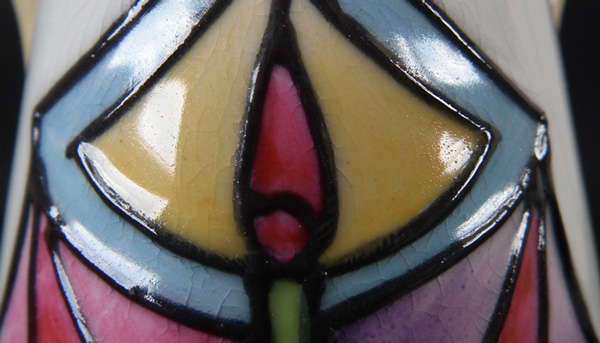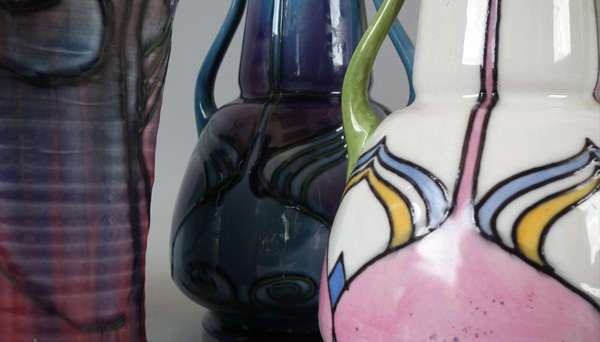
A Group Of Minton Secessionist Vases
Minton Secessionist - In a nutshell
A range of antique Minton pottery catalogued 'Secessionist Ware' from 1902 to 1919 was produced by the Mintons factory in England. The forms marketed were generally useful, and always boldly decorative. Vases, Jardinieres, Bowls, Chargers and Candlesticks can be found. Top designers of the period, Leon Solon and John Wadsworth designed much of the output.
Mintons named the wares 'Secessionist' to associate the new style with the already famous Viennese Secessionist movement that was influencing taste and fashion throughout Europe, breaking away from all 'traditional' art. In the rapidly changing society of post-Victoria 1900-1920 bold departures from traditional art were everywhere.
Top
Minton Secessionist Vase Art Nouveau Style Pattern
Minton Secessionist's Charm
Minton Secessionist wares excite decorators and designers young and old with their vibrancy and form.
Top
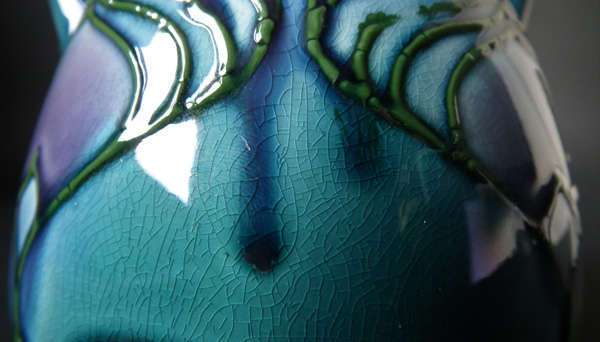
Typical Minton Secessionist Glaze Run
Minton Secessionist Manufacture
'Minton Secessionist' pottery is typically tube-lined then coated inside and out with colourful, hard wearing glazes that became glass-hard when fired.
They were commercially inexpensive to produce as many colours could be applied to the biscuit, then fired just once, ideally without running into each other though this was not always possible. The technique can be thought of as 'majolica glazing' as many of the glaze formulae were inherited from Minton's majolica era, launched in 1851 but by 1900 had fallen out of fashion.
Top
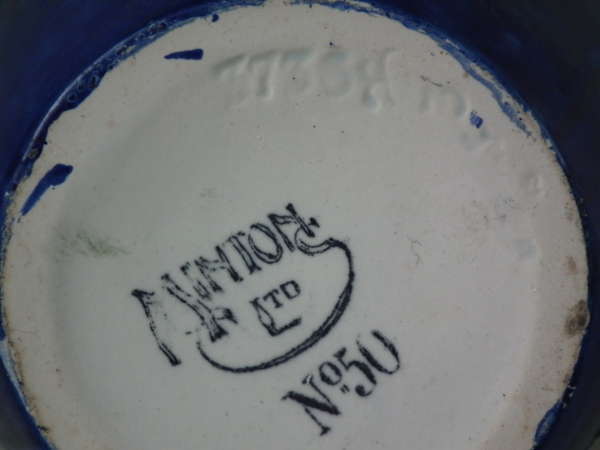
Minton Secessionist Maker's Marks
Minton Secessionist Marks
Unfortunately no publication illustrates all the numbers, styles and forms. What the numbers represent is still a mystery.
If they were batch numbers one would expect the date of manufacture to follow the sequence but they do not. The great variety of No. 1 styles, forms and colors woud suggest this was the ‘launch number’. Appendix 4 in 'The Dictionary of Minton' by Paul Atterbury and Pauline Atkin contains a black and white copy of the 'Secessionist Ware Catalogue 1902' where the highest number represented is No.61. If they were ‘Design Folio’ numbers one would not expect a number as high as No.61 to appear in the earliest of the catalogues printed.
Possibly an online photo collection of items and their marks might help with numerous dealers and collectors uploading their archive pictures.
Top
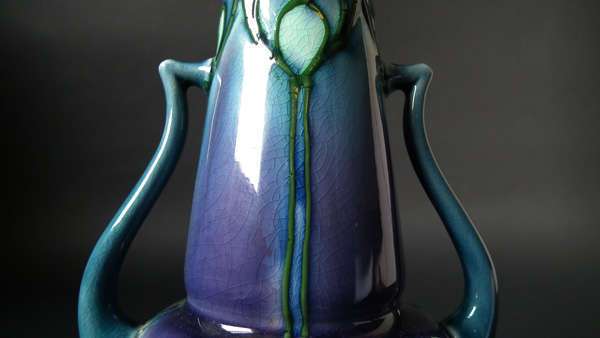
Minton Secessionist Vase With Handles
Minton Secessionist Value
Value is highest for:
Rare pattern/form combinations
Examples in mint condition.
Restoration is important as it seriously affects value. When buying, always ask. A seller who is not sure either does not know or will not tell.
Patterns of particular appeal
Top